Showing posts with label studying and questioning. Show all posts

Saturday, October 11, 2014

Does anyone actually read Gertrude Stein? (A Book Post)

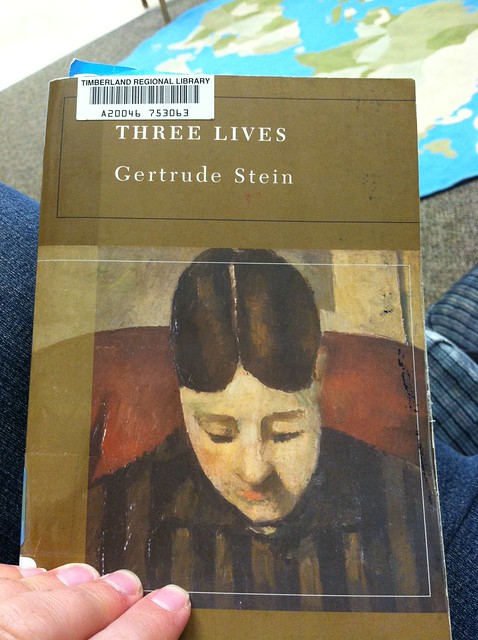
Three Lives by Stein

I am still plugging away at my 14 x 14 in 2014 Reading Challenge, but with the realization that time is short I'm looking for more books that are "double dippers" and apply to more than one category of the fourteen. 

Since one of my categories is "Books to Read Before You Die" and another is "Women's Studies" I took the step of flipping through the 1001 Books to Read Before you Die looking for books written by women.  It's a depressingly smaller list - and forget about the selections from pre-1800. I was very discouraged as I flipped through the book and then it randomly opened to a page on Gertrude Stein.

Of course I know who Gertrude Stein was - she's notorious as part of that ex-pat group from pre-WWI, and as a lesbian.  But although most people I know seem to know who she was, no one seems to actually read her writings.  Her books were not part of any college course I took (including the Women's Lit class) - does anyone actually read Gertrude Stein?

I chose to read Three Lives and had a mixed experience with it.  Her narrative style, which avoids sticking to a plot line and instead seems like the sometimes repetitive descriptive style that would come from verbal communication, was refreshing and engaging for me.  This book is really just a trio of character sketches, describing the lives of three unrelated women: one controlling spinster german servant, one black woman, and one young german girl who was brought over and married off into another german family. 

I loved the first sketch, of "Good Anna".  Perhaps I just felt a kinship with her:

"She worked away her appetite, her health and strength, and always for the sake of those who begged her not to work so hard.  To her way of thinking, in her stubborn, faithful, german soul, this was the right way for a girl to do."

But when I got to the second life, that of Melanctha, I just couldn't tolerate the racism enough to actually finish reading it - so sadly I don't know what ended up happening to Melanctha.  I know the time period being what it was that I should try to read this in the context which it was written, but I just couldn't do it.  Boo to that.

And then, soured by that, I didn't enjoy the third sketch as much either.  By the time I skipped to that, I was spotting more racism and was irritated by the attribution of personality traits to the "natures" of various ethnicities. 

So, mixed results but at least now I can say that I actually have read Gertrude Stein!

Thursday, July 17, 2014

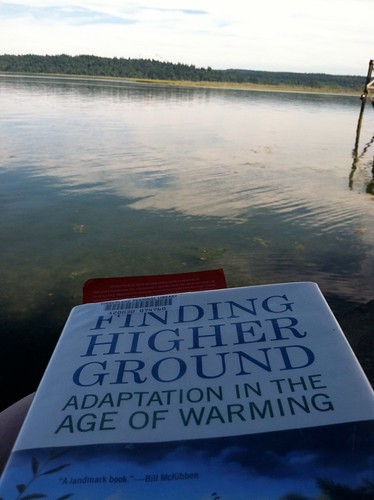
What I'm Reading: Finding Higher Ground

IMG_3158

Climate change is a depressing topic, let's be honest.  Whenever I read another book about it, I typically feel guilty, sad, mad, fearful, and depressed.  And yet, I can't stick my head in the sand and pretend this isn't happening - it's real, it's here, it's happening, and what are we going to do about it?

Finding Higher Ground: Adaptation in the Age of Warming by Amy Seidl was a different kind of climate change book.  Here, there is very little doom and gloom and more tales of fascinating adaptations that are already taking place in the natural world, and the challenge for more adaptation in our cultural world.  Seidl tells us about drought resistance evolving in plants, about changing migration patterns for birds and butterflies, and about folks experimenting with rice farming in Vermont.  She looks at solar energy and local food sheds, and challenges the reader to think of their own higher ground.

A quote from the book:

But higher ground also lies in territory beyond these pragmatic actions.  it is in our determination to care about what we love, to protect life that is threatened, to grieve for what is lost, and to believe that we can endure the Age of Warming.  The biological and cultural environments that we have depended upon in the past will undoubtedly change.  But the adaptations we bring into existence will be the very makings of our persistence.

I highly recommend this book!

Wednesday, July 2, 2014

Half-Way There Reading Challenge Review

reading post

As of the end of June, half of my 2014 reading year is up.  How am I doing on my 14 x 14 in 2014 Reading Challenge?


One Category Finished: Children's Lit

What fourteen children's books did I read (with my kids)?


  1. Children's Lit
    1. Squire by Tamora Pierce
    2. Lady Knight by Tamora Pierce
    3. The Burning Bridge by John Flanagan
    4. The One and Only Ivan by Katherine Applegate
    5. The Book of Three by Lloyd Alexander
    6. A Dog Called Homeless by Sarah Lean
    7. Flora and Ulysses: The Illuminated Adventures by Kate DiCamillo
    8. The Red Pyramid by Rick Riordan
    9. Throne of Fire by Rick Riordan
    10. Shadow of the Serpent by Rick Riordan
    11. Summer of the Gypsy Moths by Sara Pennypacker
    12. The Incorrigible Children of Ashton Place: The Mysterious Howling by Maryrose Wood
    13. The Incorrigible Children of Ashton Place: The Hidden Gallery by Maryrose Wood
    14. The Icebound Land by John Flanagan
Of these, my favorites were The One and Only Ivan  and Summer of the Gypsy Moths, both because they were about real life issues of home, independence, and relationships and both because they were heartfelt without being too maudlin.  A Dog Called Homeless was also very heartfelt (and it made me cry while I read it out loud) but it was a bit too obvious in its emotional manipulations.  Flora and Ulysses was quirky and adorable, and a really fun book that had us all saying what is this book about?  What is going on!? but in a good way.  The Incorrigible Children series is great silly fun and a great vocabulary builder - it's one of those books that uses the big words and then also explains what they mean to the kids but it makes sense and doesn't break up the flow of the narrative.  The rest on the list were also good, but pretty standard fantasy adventure fare.  Not that I don't enjoy fantasy adventure - I do!  

One Category Half-Finished (so on track, I guess): Books Made Into Movies 

  1. Books Made Into Movies
    1. The Great Gatsby by F. Scott Fitzgerald
    2. Ender's Game by Orson Scott Card
    3. Horns by Joe Hill
    4. The Old Man and the Sea by Ernest Hemingway (*double dipper)
    5. Divergent by Veronica Roth
    6. Cloud Atlas by David Mitchell *(double dipper)
    7. The Fault In Our Stars by John Green
This turns out to be a diverse collection - lots of different sorts of books get made into movies!  I'm also trying to watch the movies after I read the books, but I haven't seen the newest (not available on netflix yet) from this list. I did not like the adaptation of Ender's Game into a movie - the book was much better.  I did like the adaptation of Cloud Atlas (a crazy book to even try to adapt into a movie!) and the movie of The Old Man and the Sea is so faithful to the book I could say lines out loud right before the narrator said them on the movie.  Oh - and I watch both versions of Great Gatsby.  Gotta go with Robert Redford on this one!

None of the other categories are on track, although many are very close at either five or six books read:

1.  Religion, Ethics, Philosophy, and Spirituality
2.  Self-Improvement and Lifestyle
3.  Work Related
4.  Science and Psychology
5.  History
6.  Just for Fun Reads

And then some are really trailing at only 3 or 4 books read:

1.  Parenting
2.  Women's Studies
3.  Poetry
4.  Books to Read Before You Die
5.  My Favorite Detectives
6.  Around the World, in Alphabetical Order

For the full lists, you can look at my Challenge Page.   OK - enough blogging, I need to get back to reading!


Friday, June 13, 2014

A Sense of Earned Righteousness

IMG_0544

 I'm still working my way through to read the entire Bible, in my Mother-Daughter Bible Study.  But, honestly, we got pretty bogged down by the point we reached Chronicles.  This is not just a book - this is a collection of books and some of it is pretty tough on the reader.

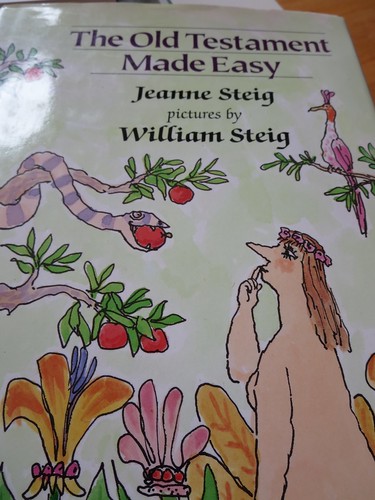
So I thought it was pretty funny when I was browsing in the used bookstore in town and found a very slim volume by Jeanne and William Steig called The Old Testament Made Easy.  It is far too slight a book to really be covering the whole Old Testament - and I was right, it jumps breazily through, with recommendations like "unless you like stats, just skip the begats".  It's cute and funny, all around.

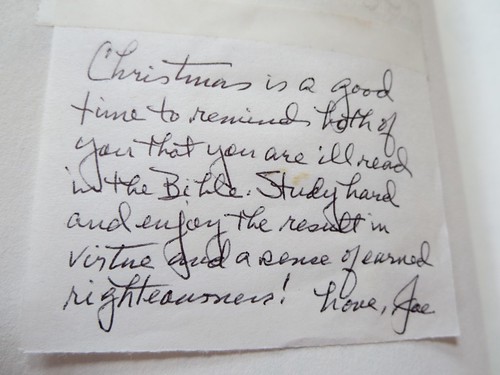
But it was even more fun to discover this note, taped, in the front of the book:

IMG_0546

It says "Christmas is a good time to remind both of you that you are ill read in the Bible.  Study hard and enjoy the result in virtue and a sense of earned righteousness!  Love, Joe."

The fact that the note was taped into the book and not directly written on the pages is also funny - was it taken from somewhere else and put in this book as a joke?  Or was the note ironic to begin with?

And a sense of earned righteousness - that is perfect!  That is just what I feel as I work my way through the difficult reading (Not skipping all the begats, either!).

Friday, May 16, 2014

Weekly Book Post

IMG_2960
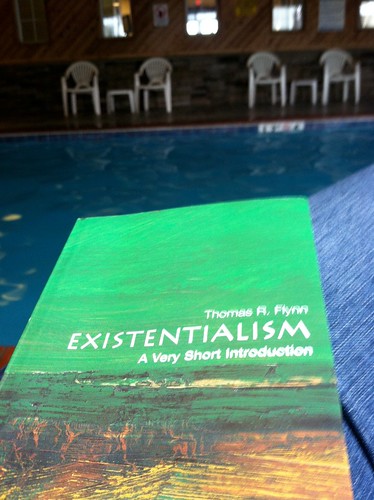
Poolside reading, anyone?

I'm progressing at a decent clip on my 14 x 14 Reading Challenge, but my mother - my mother is a crazy reading machine!  She is actually adding on new categories, and it looks like she will do a 20 x 14 Challenge this year.

My competitive spirit was chastened, but I just have to give her kudos for the gusto she brings to reading and learning.

On my side of the challenge, I have finished 56 books so far this year.  I'm enjoying having the time to read more novels and "fun" books, but I've also made an important realization about my own lifetime learning.

I really like philosophy and theology and Big Ideas, and it doesn't matter if I have an official assignment to read them or not.

BUT ... and it's kind of a big But ... if you are going to read this type of book for fun it seems you need to be careful not to bore your friends and family to death babbling on about them.

It's not just a problem that readers have, either.  My son loves to tell me all about the latest video game obsession he has, and I try, I really do try, to be interested.  But so often it just goes in one ear and out the other.  Recently I was talking to my husband about the book I just read, Existentialism: A Very Short Introduction, and the look on his face suddenly reminded me of how I imagine I look when my son is talking about his video games.  I was guilty of just talking at my husband and it was making him glaze over.

There are many topics and ideas in this world that we can become excited about, and there is nothing wrong with just learning for learnings sake.  You don't have to get a grade for it, and you don't have to even share it with others.  Just Read.  Just Learn.  Just Think.  And enjoy!

Saturday, April 5, 2014

Things I Learned in March

lessons learned in march

I'm a few days late with this, but here is my look back at the last month to see what I learned from it.

1.  I stopped ordering from Amazon this month, after deciding I could no longer support their employment practices, and I learned that I could do without it except for hard-to-find used books, which is going back to the original Amazon business model.  All the other odds and ends I had gotten into the habit of ordering through them can be found in local shops, ordered from different online businesses, or we can simply do without them.

2. This lenten season my husband and I gave up alcohol for Lent, and learned just how much alcohol is part of the normal social life. I had expected to find it difficult to not enjoy a glass of wine or a cocktail in the evening with my husband, but I had not thought about the times when drinking is part of social interactions with others. Whether it is beer at soccer games, wine at a professional gathering, or drinks with a nice dinner at a restaurant, we just hadn't noticed how much alcohol moves the social scene.  I have a whole new sympathy for those struggling with alcoholism or who simply do not drink, when it seems to be so saturated in our culture.

3.  Reading the book Six Degrees has been horrifying and galvanizing, and I've been reminded yet again that I need to dedicate myself to a low-carbon lifestyle and advocating for a collective shift to a low-carbon society.

4.  My mother and I studied the Psalms this month in our Mother-Daughter Bible Study, and learned that we were both disappointed by the psalms and disturbed by how much "my enemy" language they contain.  I still struggle to pull the religion of universal love out of the religion of tribal loyalties and judgment.


DSCF0353

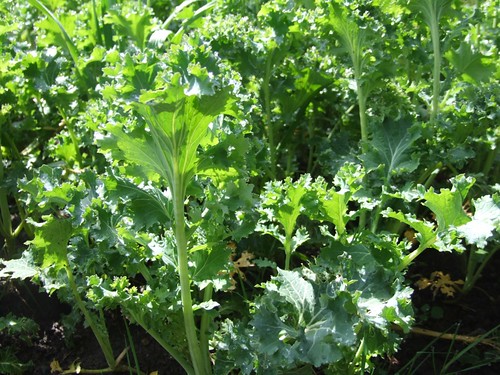
5.  I learned that the kale I planted in August was able to overwinter and is perfectly lovely to eat in March.  I also relearned just how much I love my land and my garden and life here once we are past the winter.  The sun really does come back and spring returns and I can happily live here without ever leaving the gates of my own property.


DSCF0219

6.  I had heard it was possible, but this month I verified that I can sprout leeks from the cut off bottoms of other leeks.  I kept the bottoms from some grocery store leeks, started them in my kitchen window, and then planted them in the kitchen garden after they were a few inches tall.  Now how well they fare will be the April learning. :)

Monday, March 3, 2014

Ten Things I Learned in February

IMG_2693

I'm writing this for the link-up over at Chatting at the Sky, which you might want to go check out.  I'm intrigued by this idea of a monthly post that reflects back over lessons learned during the previous month - so let's give this a whirl!

1.  Change is really hard for me.  I'm a creature of habit and routines, as much as I also have to be adaptable and flexible in my schedule, and big lifestyle changes can just put me into a tailspin.  This isn't really a new learning, but rather a lesson that keeps coming back to slap me in the face all over again.

2.  I Love my job.  Being away from it for an extended period of time doesn't actually feel restful - it feels stressful!  I filled February with a week of angsty self-pity, a week of crazy de-cluttering and cleaning my house, and then by the last week of the month, and the 3rd for me on sabbatical, I sort of hit a stride of just living in a more relaxed way.  It's still a work in progress, though.

3.  The vagaries of February weather can either drive you crazy or you can find a way to go with the flow.  Really, it's remarkable how much the weather affects our lives, and must be constantly taken into account.  I'm also keeping an eye on the temperature and trying to guess the last frost date, because I have a rose to prune and seeds to plant.

4.  My relationship with my husband needs to be a higher priority for me, and for him.  I need to have more time with him, as adults, no kids, and it needs to be more fun than just the weekly business meeting of "what's on the calendar, who's going to do what, what issues have come up that need a decision".  It makes me super cranky when he spends all his recreational time off without me, but I am going to have to be very proactive and clear about that if I'm going to get couple time anywhere on our calendar.

5.  I learned how to take a screen shot of something I was working on, to be able to post it as a jpeg to a blog post.  It's not rocket science, but I'd never done it before.

6.  My children seem to need more sleep than they used to, and to have more trouble falling asleep at night.  I see a shift toward needing to sleep later in the morning, unless I want cranky bears.  Everything I read about youth sleep patterns tells me this is normal, however, so I just feel blessed that we have the kind of flexible life that lets me let them sleep.

7.  I found the right way for me to read poetry and integrated that into my morning routine this month.

8.  I learned some distressing things about Amazon's employment practices, and decided to try and wean myself off of purchasing everything through them.

9.  A friend pointed out to me that as a homeschooler I could get an institutional library card, letting me have 50 more books out at a time - and that has been a lifesaver!  I also realized that I need to always take a book cart on wheels with me, as a couple weeks I had so many books I hurt myself carrying them all.  The library is my favorite resource and we are reading up a storm around here!

10.  Reading Hands Free Mama, I discovered the inspiring and practical idea of a life list, and have been working on crafting my own life list.  I hope that having a sense of clear purpose will help me decide what is important and what can be a lower priority in my life.

Monday, February 24, 2014

A Poem a Day

DSCF0206

One of my reading goals for 2014 is to read 14 books of poetry.  I haven't been much in the habit of reading poetry, although there are some poets I enjoy a great deal (Marge Piercy and Denise Levertov have been my favorites), and this goal of 14 books of poetry is a "stretch" goal for me.

But I quickly realized that sitting down and reading a book of poetry straight through didn't work for me.  Each poem seems to demand more digestion time before I move on and take another one in, and so they lose their beauty when I consume them too quickly.

The solution seems to be A Poem a Day.  Or more than one, but it just depends on the poems and the day.  The point being, I am trying to sit down at my desk, coffee and journal at my elbow, and start the day with a poem.  This comes right after my morning yoga/stretching, and right before reading out loud to my kids from their latest chapter book.

It has proven to be a delightful way to start the day!  So far I've read Sands of the Well by Levertov, and now I've started Leaves of Grass by Whitman.  Suggestions of other poets most welcome!

Thursday, February 20, 2014

Weekly Book Posts: Lifetime Reading Plans

DSCF0207

Do you have a lifetime reading plan?  There are lists out there, such as Fadiman's, or the book I own 1001 Books You Must Read Before You Die, and any one of these lists could be a good starting point if you are interested in making a lifetime reading plan.

There are some arguments to be made against any effort to establish a literary canon of what is good literature and what isn't, with the most compelling being that it often privileges the works of dead white guys over the voices of the marginalized or different.  But when I look at most lists now, they are clearly making an effort to branch out and be more inclusive.

So what is cool about a list like this?  It is challenging, it takes us further as readers than browsing our local bookstore would, and it can remind us to read older works.  But mostly, for someone like me who is a lover of reading and listology, it's just compelling and enjoyable to try and read them all and keep track as I go.

DSCF0209

One of my 14 x 14 in 2014 categories is "Lifetime Reading Plan", and I am using the 1001 Books to Read Before You Die list to select 14 titles I had not already read and to read those this year.  So far, I've read The Old Man and the Sea (a double dipper, since it also counts for my category of "Books Made Into Movies").  I very much enjoyed this sparse and taut little novella about man versus nature.  My next pick from the list is Crime and Punishment.  

What books would you consider "must-reads" in a lifetime?

Saturday, February 1, 2014

Weekly Book Post: Gone Girl, The Testing, and The Book of Job

I'm very much enjoying the phenomenon of being able to read anything I want (after 3 years of most of my reading time going to books required for my credentialing as a religious educator through the UUA).  I'm enjoying fiction again!

But I have plenty of books on religion-related topics to go through too, especially after our minister brought the gleanings from his bookshelf clean-off to my office.  I get first dibs, and if I don't want them, they go to the used-booksale fundraiser my church is doing for our affiliated homeless shelter.  So far, I seem to want about half of the books - and there are a lot of them!


IMG_2636

So that is a glimpse into the near future for me as a reader, but here is the report of the last week in my reading life:

The public library gave me a wonderful pile for my bedside table:


DSCF0168

But I found myself completely engrossed, obsessed, unable-to-stop-reading-into-the-night, one particular book:


DSCF0169

Gone Girl by Gillian Flynn is a He Said/She Said back-and-forth portrait of a marriage-gone-bad.  Very, very bad.  On their fifth wedding anniversary, Nick is called home by a neighbor to discover his house standing open and his wife, Amy, gone.  There are signs of a struggle, and the police are called.  But everything seems to point to Nick, himself, including Amy's diary entries that are interspersed between Nick's chapters.

But wait ... it's not that simple a story.  In fact, because I'm bad this way, I flipped to the back of the book and read the last few pages.  I thought I knew what was going to happen based on that cheater's glimpse, but then ... no another twist ... wait now ... oh goodness ... I finally got to the ending and NOW, reading it a second time, suddenly it meant something completely different to me!

It's dark, it's sad, it's violent (although not gratuitously so - mostly it's psychological violence), and it does not end with a "and they lived happily ever after".  But, wow, I really got sucked in and Flynn's writing at times rose to lovely heights of prose.  In short, I loved this book.

Which probably set me up to be disappointed in the next book I picked up after that, but really, The Testing wasn't very good.  I'm not even sure why I checked it out from the library in the first place.  The premise (very much like The Hunger Games) is a dystopian future after 7 Stages of War have left the world scarred by radiation and chemical damage and the human population a fraction of what it used to be.  One central city controls various colonies, and after high school graduation those who are deemed to be potential leaders are sent to the capitol city for "The Testing" to possibly get into the university.  But the Testing is not safe ... and blah, blah, blah.  A female protagonist must navigate her way through deadly competition to try and survive, etc.  It's basically just the little sister of the Hunger Games.  But it would be a funny gift to give someone who has serious test anxiety.


On a completely different note, I also read The Book of Job: When Bad Things Happened to a Good Person by Harold Kushner.  My Mother-Daughter Bible Study has finally progressed to Esther and Job, so we are also reading commentary on those books right now.  And I am so glad I picked up Kushner's book, because I didn't think I was going to enjoy Job.  I, probably like many of us, thought I knew the story - and thought it was a pretty stupid story.  God does horrible things to Job because of a bet with Satan, but Job remains faithful, so yay for God.  I got a little more insight from Marcus Borg, but I still wasn't looking forward to reading this part of the Bible.

Kushner brought it to life for me.  He walks, slowly, through the verses, dwelling on some, explicating and explaining, and taking little sidetracks as he pleases.  The author, a Rabbi, is no stranger to tragedy, having had his own son die of a rare illness that made him age prematurely, and he previously wrote When Bad Things Happen to Good People.    Now he applies that thinking to The Book of Job, in a work that I found intellectually clear and honest, but also emotionally honest and comforting.

Next up for me: I'm starting C.S. Lewis's Reflections on the Psalms and Horns by Joe Hill.  An eclectic pairing. :)

Wednesday, November 27, 2013

What I'm Grateful For

DSCF0004
(Feeling grateful even for small harvests)

This month my Facebook newsfeed has been full of people posting their 30 Days of Gratitude.  I blogged my 30 Days of Gratitude last year.  But this year, I decided not to participate.

It's not that I'm against feeling grateful.  I'm not ... we should reflect on what we are grateful for and as a mindfulness practice I find it very helpful.  I think we should pause to note the abundance that we already have, especially in the season of harvest and before we hit Consumer-Christmas.

But, at the same time, the public naming of gratitude has a bit of the image-crafting problems that Facebook has brought into our online culture.  Although I'm sure folks are usually just being genuine with their gratitude, the over-all effect of everyone listing all the things they are grateful for is ... a bit braggy.  A bit off-putting.

Maybe it's just that, as Americans, we can turn even the 30 Days of Gratitude into a competition.

I found this quote in a book I'm reading right now:

If we only wanted to be happy, it would be easy: but we want to be happier than other people, which is almost always difficult, since we think them happier than they are.

--Charles de Montesquieu

When we edit our lives to highlight the best parts, we are projecting a fake life for all to see and admire.  It's something most people do all the time, and I do not believe it to be malicious.  It may even be appropriate to a large extent - airing our dirty laundry or complaining on the internet all the time would be a bit of a drag and show inappropriate boundaries.  But still .... cumulatively we are all guilty of raising the bar of expectations so high that now we can all feel like failures.  Cumulatively, mind, so please don't feel bad individually.

So, I'd like to say this about my own gratitude:


  • I am so grateful for the blessings I have received, which are many.
  • I love my family very much.
  • I can lose sight of my blessings when I think of all I want or all I should do.
  • It really is true, that it's not having what you want, but wanting what you have. 

I wish all a joyous and gratitude-filled Thanksgiving.  

Sunday, November 10, 2013

Weekly Book Post: Zealot

DSCF0005

After the author Reza Aslan appeared on The Daily Show for an interview that was almost fawning in how much interviewer John Oliver said he had loved the book, I put Zealot: The Life and Times of Jesus of Nazareth on my TBR list.  Then there was his interview on Fox, which I heard all about (Buzzfeed calls it "the most embarrassing interview Fox has ever done").  All that buzz bumped it up my list and I bought it on kindle rather than wait in line for the copy from the public library.

And I wanted to really like it, I really really did.  It starts off with almost theatrical flair in an incredible prologue that describes the assassination of the high priest in the courtyard of the Temple in Jerusalem, and Aslan's writing is very engaging and has great storytelling value.

But that was the problem, too ... it was sooo dramatic and confident that I found myself wondering how much I could trust the historical validity of this book that is supposed to be about the historical Jesus.  And then Aslan presents a lot of analysis of the gospels as a way to read through them to the kernel of truth they were based off .... but once again there was so much confidence in the one interpretation without much (any?) discussion of how that interpretation can really be done like that.

In the end I find myself agreeing a lot with the review published in The Jewish Review of Books, which throws a lot of doubt on Aslan's overall serious scholarship, while agreeing that his writing is engaging and entertaining.  It was an interesting read, and definitely more entertaining than your average scholarly history book, but I don't know that I trust this interpretation of the historical Jesus all that far.


Saturday, July 13, 2013

Weekly Book Post: Pleasures of Reading and Christianity After Religion

DSCF9406

This week I've learned a lesson - one I've heard for a very long time - Don't Judge a Book By Its Cover.

Two books in my TBR pile had rather, well, bland covers.  And as I pulled books off the pile to read, those lingered unread.  I left them until I noticed that their due dates at the library were getting close, and I should try them out.

Both turned out to be books I enjoyed very much.

The Pleasures of Reading in an Age of Distraction by Alan Jacobs is a love letter to the act of reading.  It briefly flirts with brain science, the "threat" of new technologies, and doom and gloom prophecies of the death of reading, but then quickly dismisses those concerns.  Jacobs advises us to read at Whim, to read because we want to, to read to challenge ourselves, and to read to join in the conversation.  It was a balm to my soul, actually, after all the books such as The Shallows that I've read recently.

Christianity After Religion by Diana Butler Bass is a love letter to religio (that which binds us together) and experiential spirituality.  She examines all the evidence that institutional religion is on the decline, and then proposes that yes this may be true but we may also be in the midst of a rebirth of transformative experiential religion, or a Fourth Great Awakening.  Another balm to my soul - things decline but change is part of transformation.  These are hard times, not the end times, as Bass says in the book (quoting John Stewart).

Friday, July 5, 2013

Weekly Book Post: Reading the Bible Again, To Kill a Mockingbird, Justin Morgan Had a Horse

DSCF9263

This last week I finished two books: one for my credentialing work and one just for fun.

 Reading the Bible Again for the First Time: Taking the Bible Seriously but not Literally by Marcus Borg is simply the most amazing book explaining the Bible that I've read yet.  Borg is scholarly but not afraid to express his own faith as well, and overall this is an explanation of how to read the Bible that strikes me as insulting neither my intelligence nor my spirit.  One of my favorite notions from the book is "post-critical naivete", or the state of mind one reaches after you have realized all is not as it first appeared, yes there are things to think critically about, and yet you are once again open to experiencing the work with an open mind and take wisdom from it.  Love this book!

DSCF9267

My "just for fun" book was To Kill a Mockingbird by Harper Lee, one of those great classics that somehow I haven't found time to read yet. And I'm so glad I finally rectified that situation - this is a fantastic book.  The characters were all painted so lovingly, and the narration by the young girl, Scout, allows the reader to see a scary and tragic situation, time, and place through the innocent eyes of a child - and thereby see something actually more nuanced and real than it might have been otherwise.

And then the kids and I listened to Justin Morgan Had a Horse in the car this week.  My daughter didn't want to, because she holds that "all horse books are too sad".  But I made her listen to it anyway, and she was glad she did.  It has a few parts that are a teeny bit sad, but they are sketched with a light hand, and in the end all is well.  The War of 1812 makes an appearance, but once again sketched with a very light hand.  A good historical fiction piece for children.

Friday, May 31, 2013

Weekly Book Post (The Shallows, How Children Succeed)

DSCF9062

This week I've read two books about our malleable brains.

The Shallows: What the Internet is Doing to Our Brains by Nicholas Carr came out a couple years ago, so I'm behind the curve on talking about it, but I enjoyed this story of how the intellectual technologies we use change the way our brains are 'wired'.  Part defense of old-fashioned book reading, part natural history of the human brain, and part warning and social analysis of our new digital selves, this is a well-written and engaging book.  My take-away was the notion that our brains are always malleable, and that we expose ourselves to and habitually do will have neurological consequences for us.  So while I'm not ready to ditch the internet altogether, I am noticing how and when I use it, and I'm trying to stop mindlessly surfing just because I'm bored, and stop multitasking such as surfing the internet while also watching a TV show.

How Children Succeed: Grit, Curiosity, and the Hidden Power of Character by Paul Tough is a more recent book.  The author sets out to look at what makes children succeed (success seems to mean graduating from college and earning more money as an adult, with some other markers being health and avoiding jail and early pregnancy) and how we can influence this success.  Character traits, rather than cognitive scores, are identified as the largest influence on success, and those character traits are revealed to be both malleable and teachable.  Tough tells the story of the KIPP programs, a successful chess program in a low-income public school, and the efforts in an exclusive and expensive private school to address character issues in kids who never get to experience failure.  He also tells us about the latest research in Adverse Childhood Experiences, stress-management, and long-term health and mental consequences.  It's a well-told story, and one I think parents and educators should read.

The pairing of these two books, along with The Power of Habit, which I read a month ago, has me cogitating about our malleable, changeable brains and the notion that in many ways we become what we habitually do and are habitually exposed to.

Monday, May 13, 2013

Don't Be Afraid to Innovate

DSCF8997

We worry so much about finding the Perfect Solution, as if there is One Right Way to educate our children (or do anything else).  But this book I read last week and the this video I watched this morning pair together to remind me that innovation involves experimentation and FAILURE.  Fail early and often, but just keep trying new things!  We can't be afraid to fail, or there are so many things we will simply never try in the first place.


Quotes from A Simpler Way by Margaret J. Wheatley:

There is no such thing as survival of the fittest, only survival of the fit.  This means there is no one answer that is right, but many that might work.  Life explores all sorts of combinations, content to find anything that works.

We could give more support to our own experimentation if we focused on discovering pretty good solutions that worked for now.  With more to choose from, with more bidding for support as the ultimate right answer, we might feel less attached to them.  If these solutions did not require such enormous investments of resources, ego, and certainties, we could abandon them sooner if they stopped working.

So try something new.  And then stop it if it doesn't work.  If it does, great, but stay open to tweaking it again in the future.  This was the educational philosophy I was raised with: nothing works for every child, and nothing works forever.  So follow the lead of the child right in front of you, and do what is right for them, right now.  Be ready to change when that stops working.

Thursday, May 9, 2013

Weekly Round-Up

I find so many interesting articles and ideas when I'm reading online, and I enjoy other weekly link lists a great deal, so I want to try it on my own blog, and put a list of links up once a week.  A curated list of what I've found of interest this week:


What have you found thought-provoking this week?


Wednesday, May 8, 2013

The Reading Life: The Year So Far

This is what I've read so far this year, not counting books I read to the kids:

1. Everyday Spiritual Practice by Scott Alexander
2. The Eyre Affair by Jasper Fforde
3. Youth Ministry Advising: A Complete Guide by the UUA
4.  Winter: A Spiritual Biography of the Season edited by Gary D Schmidt
5. Faith Without Certainty by Paul Rasor
6. On Religion: Speeches to Its Cultured Despisers by Friedrich Schleiermacher
7. Making the Manifesto: The Birth of Religious Humanism by Bill Schulz
8. Reason and Reverence: Religious Humanism for the 21st Century by William Murry
9. Making a Way Out of No Way: A Womanist Theology by Monica Coleman
10. Religious Naturalism Today: the Rebirth of a Forgotten Alternative by Jerome Stone
11. Proverbs of Ashes: Violence, Redemptive Suffering, and the Search for What Saves Us by Rita Nakashima Brock and Rebecca Parker
12. The Feminist Ethic of Risk by Sharon Welch
13. The Minimalist Vision of Transcendence by Jerome Stone
14. What Americans Really Believe by Rodney Stark
15. Varieties of African American Religious Experience by Anthony Pinn
16. Process Relational Philosophy: An Introduction to Alfred North Whitehead by Robert C. Mesle
17. Alone Together: Why We Expect More From Technology and Less From Each Other by Sherry Turkle
18.  The Power of Habit: Why We Do What We Do in Life and Business by Charles Duhigg
19.  We Have Been Believers by James H. Evans, Jr.
20. Mind in the Making: The Seven Essential Life Skills Every Child Needs by Ellen Galinsky
21. Dating Jesus: A Story of Fundamentalism, Feminism, and the American Girl by Susan Campbell
22. God Believes in Love: Straight Talk About Gay Marriage by Gene Robinson
23. The Dirty Life: On Farming, Food, and Love by Kristin Kimball
24. Letting Go: Transforming Congregations for Ministry by Roy Phillips
25. Theories of Development by William Crain
26. Present Shock: When Everything Happens Now by Douglas Rushkoff
27. Sticks and Stones: Defeating the Culture of Bullying and Rediscovering the Power of Character and Empathy by Emily Bazelon
28. The Little Bookstore of Big Stone Gap: A Memoir of Friendship, Community, and the Uncommon Pleasure of a Good Book by Wendy Welch
29. When Women Were Birds: Fifty-four Variations on Voice by Terry Tempest Williams

Thursday, May 2, 2013

Weekly Book Post (Alone Together, Present Shock, Little Bookstore, Sticks and Stones, and Mind in the Making)

DSCF8662

I've read a bunch of good books this week.

Alone Together: Why We Expect More From Technology and Less From Each Other by Sherry Turkle  is a fascinating look at how humans are psychologically affected by technology.  The first half of the book (less interesting to me) was about robots and all the little fake pets and so forth that we use as well as the possible future of robots standing in for human relationships.  The second half of the book looks at The Network of internet and smart phones and how we are both more and less connected to others through the network.

This paired really well with another book that I read:

Present Shock: When Everything Happens Now by David Rushkoff is another look at how technology has changed us.  Rushkoff focused on how we perceive time, rather than on relationships, and has some fascinating bits about our biological clocks and how we perceive time.  However, Rushkoff doesn't give a lot of detail or refer to research, and that was a bit off-putting to me.  I like my research. :)

What came through to me from these two books is this one simple truth: we are biological beings.  We have tools and technology, and using those does change how we live our lives.  But the mistake we make is when we forget that they are tools, and when we try to change ourselves to match the tool rather than the tool to match us.


DSCF8961

The Little Bookstore of Big Stone Gap by Wendy Welch is a memoir of people choosing a different life and following their dream, which was in this case to start a little used bookstore in a small town.  Welch's writing is fun and funny, and I found myself wishing I could go visit their little bookstore.  It also made me feel pretty bad that I don't shop at small local stores in my town more often!  Support your local businesses!  (I have made a trip to our local bookstore this week, but my husband says I can't start buying all these books - I am a library user and I need to stay one!).

Mind in the Making: The Seven Essential Life Skills Every Child Needs by Ellen Galinsky is full of all the research detail that I like when I read.  Gallinsky has culled from many studies about how the brain develops in early childhood and about what skills are correlated with success in academics and life in general, and she has also interviewed real parents and examined successful programs.  The seven skills she says are the most important for your child to have are: focus and self-control, perspective taking, communication, making connections, critical thinking, taking on challenges, and self-directed engaged learning.  She gives suggestions for parents in how to strengthen all the areas.  I loved that almost every section suggested that the best thing a parent can do is model these skills and behaviors in their own life!

The last book I read this week is Sticks and Stones.  I wrote a blog post about it on my other blog, The Childrens Chalice.

Monday, March 11, 2013

Away from the Kids

I'm away this week, taking a graduate level "intensive" seminary course.  This is the third week in a row that I've had a training or a class that has taken me away from home, and I feel bad about doing this to my husband and the kids.

Sure, I did all the laundry and left them with a fully stocked freezer of meals, but to get through the weeks the kids are having to skip many of their regular activities and my husband has had to work from home.  We also gave them these days off "school" because it would be too much for my husband to deal with, so the kids are probably getting way too much screen time.

And yet, that didn't stop me from leaving.  It's not just that this is my job (and I do love my job).  It's also that I really love the intellectual stimulation of taking training and classes.  Taking this class right now, being here where I'm just focused on learning, is a energizing and revitalizing.  I'll return to my job and my family with new energy and ideas.

It also might not be a purely personal endeavor.  I've heard a saying many times: "you get what you are".  If you want loving children, be loving.  If you want your children to be life-long learners - be a life-long learner.