Showing posts with label social action. Show all posts

Tuesday, July 1, 2014

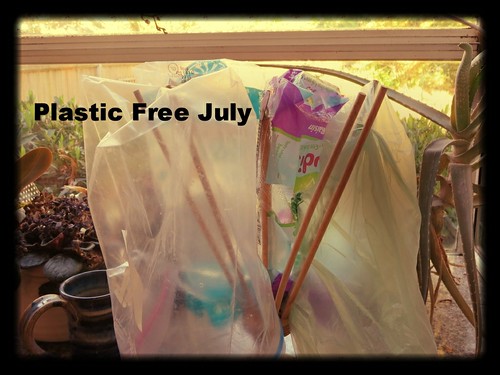
Attempting the Plastic Free July Challenge

plastic free july

I'm accepting the challenge for this month, to refuse single use plastics as much as possible.

Here's the description of the challenge:


The Challenge

The challenge is quite simple. Attempt to refuse single-use plastic during July.
"Single-use" includes plastic shopping bags, plastic cups, straws, plastic packaging...basically anything that's intended only to be used once and then discarded. If refusing ALL single-use plastic sounds too daunting this time, try the TOP 4 challenge (straws, plastic bags, plastic bottles &coffee cup lids).

The rules

  1. Attempt to refuse single-use plastic during July.
  2. Remember it's not going to be easy! It is a challenge, not a competition so don't worry about being perfect.
  3. Collect any unavoidable single-use plastic you buy. Keep in a dilemma bag and share it with us at the end of the challenge.
  4. It's up to you regarding how long you participate. You might decide to go plastic-free for a day, a week, a month or longer! However long you choose will still make a contribution.
I'd love if others joined me in this!  You can sign up for the challenge at www.plasticfreejuly.org

Monday, June 16, 2014

We Need Diverse Books

IMG_0585

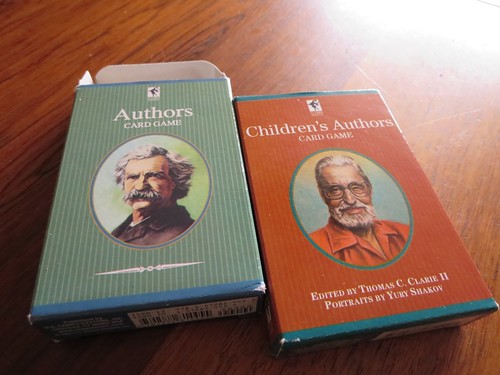
Did you ever play Authors?  This was one of my mom's favorite games when I was a kid, and I remembered it fondly.  When I recently ordered a set for my family to try out, however, I had one of those uncomfortable moments when you see a childhood thing and realize how biased it was.

The authors are all white, and there is only one woman author.  My kids noticed it at once, and I'm proud of them for that.  But darn - I really liked this game when I was a kid, and it actually greatly influenced my reading list.

And that means that I missed out on a lot of good books that would have broadened my horizons.  Reading is the closest I can come to understanding a world, a place, a time, or a life that I can't actually live.  A good book gives the reader a chance to step into other shoes in a way that nothing else does.

The We Need Diverse Books campaign has made waves recently, and it is bringing much needed attention to the issue.  Not only do we need diverse books because everyone should be able to see themselves represented somewhere in the library shelves or the bookstore, but we also all need to explore beyond our own lives and beyond people who look or live just like we do.

IMG_0547

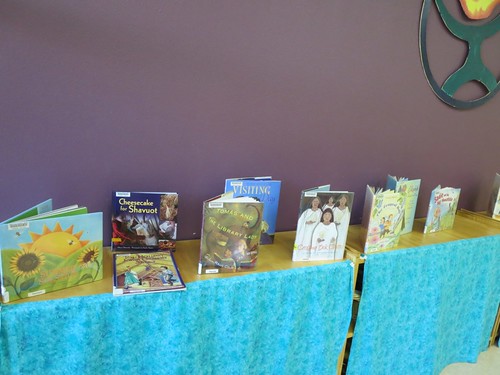
As a teacher, it is my job to surround the children I am educating (my own and the children at church) with books that celebrate diversity, promote acceptance and compassion, and open their minds to a larger vision of the possibilities of life.  All teachers should be curating the books they surround their students with, and there are helpful guides out there that can point us in the right direction.

(I also have a recommended reading list on my other blog right now, reflecting some of the good books I've found recently.)

Is it a lot of work to re-sort and re-evaluate your collection?  Yes.  But this is important, incredibly important, work that we all need to do.  And, it is also a joyful and fun task!  Goodness, there are some amazingly good books out there that are both representative of diversity and just lovely books in their own right.  If you love books, then realizing that you've only been getting just a slice of the them by reading your standards means that now you have a whole new world to explore.

But we only have them to explore if they get published, and so seek them out, buy them, and demand that publishers give us diverse books!


Sunday, May 11, 2014

Happy Mother's Day

IMG_0345


 Happy Mother's Day!  Today, you can find me over on my other blog, The Childrens Chalice, writing about a Mother's Day that extends that love out into the world.


Monday, April 29, 2013

Does this Outfit Make Me Look Heartless?

DSCF8958

Like many others, I have been horrified by the collapse of a garment factory in Bangladesh last week - with a death toll now over 300 people.  I saw a political cartoon this week, which I now cannot find again, that showed a woman holding up a garment to herself in a department store and saying "does this make me look like I'm oblivious to global working conditions?"  I'm just horrified that the real price for our cheap and semi-disposable clothing is being paid by low-wage and high-risk workers in poor nations.

I decided to do a little look through our clothing to try and figure out where most of it was made.  These two piles of my children's clothing are pretty typical: a mix of one homemade item, a few gifts, a few hand-me-downs, lots of stuff bought in thrift shops or on ebay, and a few things bought new from Lands End or Costco.  They were made in:

The Philippines
Sri Lanka
Bangladesh
Korea
India
Honduras
China
Vietnam
Cambodia
My homemade item that was made right here
and one item said "Made in the USA"

I can't personally travel to all these places to see how workers are treated in each country, but I tried googling it to get an idea.  It was actually very difficult to get any sort of information, other than a disquieting sense that, no, it's not good in any poor nation with minimal government regulations.

So what to do?  I'll keep doing some of what I have been doing anyway (for other reasons).

1.  Reduce.  There's a reason it comes first in the "reduce, reuse, recycle" mantra.  Just reducing the amount of clothing that my family purchases and owns is the best step to take for the environment, my wallet, and my laundry load.  It also would mean less contribution to the exploitation of workers.  My grandma used to say "buy quality, not quantity", and she was right.  I'm thinking about the notion of the Minimalist Wardrobe, as well.

2.  Reuse.  A lot of that clothing shown above was purchased used.  (In fact, in those laundry piles only the socks, underwear, two pairs of pants, and one pair of pajamas were purchased new.)  Yes, it was originally made cheaply, but reusing it still is better for the environment, my wallet, and my contribution to worker-exploitation.

3.  Mend what you have, or upcycle it (or when that fails use it as a cloth rag).  When clothing gets worn out around here, I fix it, or it gets upcycled into hats, rugs, quilts, etc.  When all else has been tried, it gets used as a cloth rag.  We don't use any disposable paper products here except toilet paper. However, this post isn't about disposable paper.  But mending and upcycling can extend the lifespan of an article of clothing, thereby reducing the impact to environment, wallet, and worker-exploitation.

4.  Buy Fair Trade.  This would be ideal.  But I've done a bit of internet searching about fair trade options this week and I find them slim for men and almost non-existent for kids.  I can probably dress myself Fairly, but that's partly because in my work setting and living in the Pacific Northwest I can get away with a certain "hippy" look to my fashion.  My favorite Fair Trade sources:


  • Maggie's Organics is my usual source for women's socks, tights, and leggings.  My local food co-op carries them, as well as the Fair Trade store in town.
  • Mata Traders is a Fair Trade line that is carried in the store in town, and I've purchased two sundresses from them that I'm very happy with.
  • Fair Indigo carries a good selection (for women), and I always check them out, although I have yet to purchase anything.
  • We're really lucky to have a Fair Trade store in town, that sources from all around the world but can tell you the "story" of every item in the store.  I've bought many things there and will continue to do so (such as Ethletic shoes).
Fair trade is usually better for the environment (most is organic as well as fair trade) and it's definitely better for the workers.  It is NOT better for my wallet.

5.  Buy Made in the USA.  It's really hard to find anything Made in the USA in the box stores.  But there are some websites that specialize, so that is helpful.  A cursory search, however, leaves me with the impression that I'll only be able to buy really basic clothing and stuff more suited to outdoor work or camping.  Which is fine - we need that stuff too - but it won't be a complete source.  Buying USA made is probably not really better for the environment (maybe less factory pollution because of regulations, maybe less energy used to transport it here to me?), but it is better for worker conditions and for our own economy.  Not better on my wallet.

6.  Make it myself.  I enjoy sewing, but this isn't going to become the main source of our wardrobes.  For one thing, I just don't have time.  For another, I can't make some of the stuff we need: socks, underwear, my husband's button-up shirts for work (he's particular), or jeans. And where does the fabric come from?  I like to order from Near Sea Naturals,  but if I only get my fabric there this is once gain Good for the Environment, Good for Workers (well, it's more work for me, but ) But NOT good for my wallet, or my time.


So that is my Six-Point Plan: Reduce, Reuse, Repair, Fair Trade, Buy USA, Make it Myself.  I'm really going to miss my Lands End core wardrobe staples, though.


Wednesday, March 27, 2013

God Believes in Love

DSCF8658

This week the Supreme Court is hearing two important cases about marriage equality, and it seems like a great time to tell you about a delightful book I read last week: God Believes in Love: Straight Talk About Gay Marriage by Gene Robinson.

Robinson is a retired Episcopal Bishop, and he was the first openly gay man in a relationship to become a Bishop.  In this open-hearted and simply written little book, Robinson tells about his own journey toward accepting his sexuality, his divorce from his wife, and his experience of first civil union and then marriage to his husband.  In other chapters of the book, Robinson frames the issue as a Civil Rights struggle, placing it within a larger context of history, and also examines it as a scriptural and theological issue.

One brilliant chapter in particular takes each of the most often cited as condemning homosexuality passages from the Bible and analyzes each.  I thought it was ironic that according to Robinson's analysis, the Bible is patriarchal and considers women of very low-worth, but is not really anti-homosexuality.  Most of these passages, by his understanding, are actually about not treating men as you would women - because the way that women were to be treated was as inferior and would be demeaning to men.  Still a long way to go on all of this.

Despite all the content packed into this little book, it remains easy to read and uplifting.  Robinson has a remarkable way of being righteous and prophetic, but also humble and forgiving.  I highly recommend it to everyone.

Friday, January 25, 2013

A mixed view of legacy

The theme of the 30 Days of Love this week has been "honoring the legacy".  I've been getting the daily emails, the reminders to think about Martin Luther King, Jr., the 40th anniversary of Roe V. Wade, how proud Caesar Chavez's grand-daughter feels of her grandfather, and asking folks to nominate heroes and justice-seekers.  I should feel inspired.  I wish I felt like writing posts about my heroes.

But all this talk of "legacy" (and also, the field trip the kids and I took this week to hear about living Native Traditions), has me thinking about another kind of legacy.  The legacy of privilege, prejudice, and racism.  I think it's fair to say that I'm a 1st-generation justice-seeker.  And when facing the question of "legacy", I have to be honest and confront the legacy I inherit from my family.

My family aren't particularly prejudiced.  They are good people.  But no one has ever marched for civil rights, either.  And, as European Americans, we inherit the legacy of white racism and privilege.  Yes, a few generations back many in my family faced discrimination (No Irish Wanted, etc and my german-American family had a rough time of it during WWII), but then there is also this:

When I was in Army training, there were many other young soldiers with the same last name as I have, but I was the only white one.  One of the guys asked me how I got this last name .... told me I was the first white person with this name he'd ever met, that he'd thought it was a black name.  My name is from Wales.  However, this name has a long history in America - a whole county in Virginia was the original plantation-land of this family ... and they owned many slaves.

That is an awkward conversation to have with your fellow-trainees (all 18 year olds and what did we all know about how to talk to each other about this stuff?).  A couple hundred years ago, white people with my last name probably owned your great-grandparents.  I don't know how my branch of the family is related, but in all likelihood those were some of my great-grandparents who were slave-owners.

I'd love to be writing a post about my heroes.  We need heroes, we need to embrace our heritage of justice-seeking and honor those who came before us.  But we ignore the icky bits of our heritage at our peril.  How can we move forward to build the community and the world we dream of if we haven't dealt with the baggage of the world we inherited?

Saturday, January 19, 2013

30 Days of Love Day One


Today is Day One of the 30 Days of Love.  You, too, can sign the pledge to focus your next 30 Days on Standing on the Side of Love.  Just head over to their website.

Thursday, December 27, 2012

The New Jim Crow

DSCF8221

This is the 2012-2013 UU Common Read: The New Jim Crow: Mass Incarceration in the Age of Colorblindness by Michelle Alexander.

Wow.  The subject matter is so compelling, and the more I read the more angry I felt that our society could be this unfair to people.  Alexander lays out a detailed and persuasive argument that the criminal system, especially the War on Drugs, is stacked against people of color, and that this unfair design to the system is every bit as much of a system of racial control as Jim Crow laws ever were.

Everyone should read this book.  That said, I did find that the book begins to repeat itself by the mid-point.  But even so, I still respected the sheer size of the argument Alexander has put together here.

An interesting article about the book here.

A discussion guide is available from the UUA.

In our congregation, our minister has given a sermon on the book, and we're doing a class in our Adult Education program.

Read it!

Friday, December 14, 2012

A sad day

DSCF8158

My heart is breaking over the tragic events today.  These mass-shootings are always horrible (interesting stats here), but this one feels even more horrible because the children were so young.

Yes, there are cultural issues we should talk about.  Yes, we should examine our gun controls and our mental health systems. But at some deep, deep level, this just points to our vulnerability.  Our terribly, terribly vulnerable incarnated selves and the terribly, terribly fragile receptacles of our love - all can be dust at any time.  And it's so hard to hug your babies close and to know that the world is not a safe place.

And yet the world is also a wonderful place.  How to balance this, to cherish and love life and yet to know that it will end?

My heart is breaking.  I will pray, and I will work for better gun control and mental health services. But this is also a reminder to look again at mortality, at love, and at what matters most.

(This reminds me of how I felt a few months ago when I wrote this post.)

Sunday, October 21, 2012

Living My Sermon

IMG_1167

IMG_1168 Our High School youth group decided they wanted to do something to support Yes on Referendum 74 (our state's ballot measure that asks us to vote to affirm the marriage equality law the legislature already passed).  Hypatia was hanging out with me last week as I led the youth group meeting, and she was inspired to join in.  This week she made this sign at home, and today she joined the group on the corner of a busy intersection as we all stood and waved our signs and our big Standing on the Side of Love banner.  (That's her dad behind her helping her keep her sign up in a strong wind).

I was struck by how her action today was just perfect with what my 1/2 sermon (I shared the morning with another speaker) this morning was all about:

Bringing Justice Home: Part 1


The story I told today was one that I saw done in a workshop at General Assembly this year.  General Assembly is the annual national gathering of Unitarian Universalist congregations, and this year it was a themed “Justice” GA in response to it’s location in Phoenix, Arizona. 


I think it is telling that in the story the first group to stand in solidarity were children.  This speaks truth to me, not because I think children are naturally always kind and just – in fact children and adolescents are sometimes incredibly cruel to each other.  No – it is not because they are better-natured than adults, but rather because they are not numbed to injustice yet. 

A couple years ago, my son hit that stage of reading where he was working out all the signs he saw as we drove around town.  As I was sitting at a red light, he was working out what the handmade cardboard sign being held by the person on the street corner said.  “Homeless – need help”, it said, and he read that out loud just as the light changed and I drove on about our business.  My daughter, the younger child, cried out “that person said they needed help – why aren’t you helping them!?”.

Indeed, why am I not helping them?  Because I don’t want to encourage street corner begging?  Because I am afraid that giving them money won’t actually help them?; because I am too busy, in too much of a hurry?  These are all possible reasons for any of us to pass by on any given day.  But the reason, the primary reason, I believe, is that we cease to notice the injustices and sad sights that we see too often.  We become numb to it all.

Our children and youth bring new eyes, and as such they can see more than we do.  They can also speak that truth which they see, much as the small child does in the story of The Emperor’s New Clothes when they ask “why is the Emperor naked?”.  Too often, the adults in the crowd are afraid to mention that the Emperor is, in fact, naked.

How do we get so numb, so blind, so afraid to act?  It seems that in fact this is not the natural state of the human brain, as recent studies have shown that when people look at images of others experiencing pain or violence, the viewers have the same parts of their brain activated as if they were looking at pictures of their own children.  In similar studies, when people acted to help another the same part of their brain showed activity as it would if they were experiencing personal pleasure.  These sort of studies have led some academics to propose that humans are naturally compassionate and cooperative, and that altruistic behavior has a biological foundation.

 And then other studies, such as that by Pearl and Samuel Oliner’s study of Germans who helped rescue Jews during the Nazi Holocaust, have found that memories of growing up in a family which prioritized compassionate and altruistic behavior had a strong correlation with future adult action.

With this in mind, I believe that each action I take in front my children – and every action that any one of us takes in front of a child – is important not just because of what that action can accomplish today, but because of what sort of future action will result from my modeling.  Realizing that it was not emotionally and developmentally appropriate for my children to pass by a person on the street asking for help, I helped them create care packages that we now keep in our car and can give to anyone we see on the street asking for help. 

As poet and activist Wendell Berry has written: “Protesters who hold out longer have perhaps understood that success is not the proper goal.  If protest depended on success, there would be little protest of any durability or significance.  History simply affords too little evidence that anyone’s individual protest is of any use.  Protest that endures, I think, is moved by a hope far more modest than that of public success: namely, the hope of preserving qualities in one’s own heart and spirit that would be destroyed by acquiescence.”

I feel that action is needed to preserve those qualities in my heart and spirit, and also in the heart and spirit of all who look to me as a model, those like my own children.  And when I think about the ripples of influence that all those hearts and souls living into their best selves may lead to, I have to say that it is impossible to judge the success of anyone’s individual single action.

Going back to psychological research we find the phenomenon of learned helplessness.  Learned helplessness is the phenomenon of an animal or human who has repeatedly had a negative experience internalizing the idea that they are helpless to change that experience, and consequently ceasing to even try to make a positive change.  If we repeatedly experience ourselves as helpless to effect change, we may internalize this sense of learned helplessness and just stop trying.  Learned helplessness is, of course, a self-fulfilling prophecy, since we will never effect change if we don’t even try.

I realized at one point with my children that I have learned helplessness.  We were listening to an NPR story about a controversial death penalty case, which sparked a family discussion of the death penalty.  My son was horrified that we would think it was right to ever kill anyone, and I sympathized with his point of view.  But my knee-jerk response, the one that ran through my mind was, “yeah, I used to care about that too, but it’s hopeless.  Nothing will ever change, so we should just change the channel.” 

Fortunately, I remembered how important it is to empower children, rather than to downplay their natural impulses toward compassion and justice-seeking.  It can be so hard to hold onto our impulse toward justice, and there will be enough discouraging experiences for the kids in their lives – one of those discouraging experiences does not need to be caused by me.  Responding to his interest in this issue, I helped him write a letter that we sent to several political leaders.  Did his action make a difference?  Perhaps not.  Did it make a difference to him?  Yes.   It was one of those actions that sustained the qualities of compassion and justice-seeking in his heart and soul.

It is a well-worn cliché to say that “the children are the future”, but as with many clichés there is a core of truth in the saying.  Whenever you engage in justice-work alongside a child, you are making a double investment with your time and energy.  You are making the world better today through your efforts, and you are helping to make the world better in the future through the life-long values you are helping to instill in that young person. 

In General Assembly in June, I attended a workshop called “Justice as a Family Value”.  There were many people in attendance who had impressive resumes of activisim and justice-work, but we spent most of our time talking about our childhoods.  What did we experience in childhood that inspired us to live the values of justice-seeking?  One woman remembered Socks.  She remembered that her mother would always buy extra socks, more than their family needed, and would hand those out to homeless people.  Was that personal sock project huge?  I doubt it.  However, it turned out to be huge in the life of this woman who would grow up to do many many more actions to make the world a better place.

My daughter asked me this summer what I hoped the future would be like.  I gave her a description of my best and most hopeful version of our possible future, and she smiled confidently in response.  “Ok”, she said.  “Let’s do that.”  That youthful voice of optimism inspires me.  Yes, indeed, let’s all do that.

Saturday, July 21, 2012

Worker Justice

When I was in college, one of my classmates was dating an undocumented immigrant, and said that he worked at local cheap eats place as a dishwasher - getting paid $1 an hour.

A whole buck for an hour of scrubbing dishes.  My mother paid me a dollar an hour to do chores when I was a little kid.

I haven't been able to eat at that restaurant again, but of course there's no reason for me to think that this is the only local place paying its workers such substandard wages.

When I was down in Phoenix for the Justice GA, I was struck by how many of the local activists made reference to our love of guacamole - and then I saw the local practice of having the waitstaff come out and make the guacamole fresh at the table so a restaurant patron could see how fresh it was.

I don't know how much waitstaff are paid in Phoenix, but the national minimum wage for tip workers is  $2.13 an hour.

From field to fork, it's not just the environment and the animals that suffer so we can have a good dinner.  But overall, worker justice and fair trade hasn't got the cultural traction that organic and sustainable food are now enjoying.  The lack of concern over worker justice from foodies is the subject of this recent article in salon.com.

Yet another thing for us to worry about?  Yes, as I stand in front of the dairy section of my local store, I have to ask:

How were these cows treated?


Should I spring for organic?  Hormones and antibiotics in milk products give me the willies, and I worry about my kids growing up on all these hormones ...


Maybe I should go for soy or coconut instead?


Organic, non-gmo soy?


I've heard soy isn't actually all that sustainable .... and then it has it's own hormone mimicking issues ....


Coconut milk is high in fats .... and it's a new fad so I have no idea if coconut production is sustainable or not ....


Were the dairy workers paid fairly and treated well?


How many miles did this product travel to this store?  What is it's carbon footprint?


Are the workers in this store paid fairly?  


Does this chain of stores/ local store support some political cause I'm opposed to?  (Should I even be in this store in the first place?)


It is enough to make a lot of people throw their hands up in the air and give up.  And then you have to go through that with every single purchase decision you make.  


All that said, can we find a bit of room in our overcrowded ethical brains to worry about the workers?


Wednesday, July 11, 2012

Gleaning from the Garden

IMG_0890

Today the Interfaith Camp kids walked to a community garden operated by the Kiwanis Club on the roof of a government building.  Hypatia and I got to go along, as extra volunteers.  We harvested fresh carrots and beets that went straight to the local Food Bank.  It is a wonderful garden, a wonderful use of space, and it was a wonderful morning with the kids.

IMG_0898

 Hypatia took over my phone when she got tired of pulling carrots, so we even caught me in the act.

  IMG_0922

IMG_0923

Sunday, June 24, 2012

Witnessing at Tent City Jail

IMG_0833

This is the end of GA for me, as I'm headed home on a ridiculously early flight this morning.  My flight is so early that I considered skipping the witnessing event that we were bussed out to the Tent City Detention Center last night for - I considered go to bed early so that I would get more than 3 hours of sleep.

IMG_0830

But I didn't skip it, and I'm very glad I attended.  It was the first such protest that I've ever been to, and I was deeply moved by the overall experience.  Standing in a huge crowd of yellow T shirts, singing and cheering and waving our (electric) candles, I was deeply humbled.  This issue has not grabbed my heart until yesterday, but now I get it.  I finally get it.

Wednesday, June 20, 2012

The Doctrine of Discovery

Here is some of what we're learning about and talking about at the Unitarian Universalist General Assembly right now:


The day today was moving and powerful, and exhausting.  It is all so BIG, and there is SO MUCH work to do.  But, as one speaker said today, when Hate shows itself, Love has to show up too.

Friday, November 18, 2011

Care Packages for the homeless

Carbon is reading every sign and everything we pass, especially when I'm driving. Now that he's finally got the letter-reversals mostly under control, the Code is Cracked and he's loving being able to read things for himself.

So it's a rainy day, and I'm taking them to PE at the YMCA. We are stopped at a red light, and there's a homeless man standing at the corner with a hand-lettered sign on a piece of cardboard. Carbon sounds it out: "Homeless. Please Help", and he reads it out loud just as the light changes and I start to drive away.

Hypatia yells "he was asking for HELP! Why didn't you stop?"

Indeed. Why didn't I stop? Because I don't know how best to help him? Because I'm afraid that giving him cash won't really help? Because I don't usually carry much cash? Because I'm embarrassed to hold traffic up? Because, honestly, it gets tiring to keep seeing other people's pain and a numbness takes over where you just stop looking?

None of that is good enough for my kids. None of that is good enough for my own best self, either (and my kids are like the external manifestation of my own best self - and worst self too, of course. All about the extremes, young people). The kids want to help, and they need something tangible they can do.

So we talked about what would help, if you lived on the streets. We don't want to give them money to spend on alcohol or drugs, if that is part of why they are on the streets. But we want to give them something. In the end, we went to the big warehouse store and got batteries, those instant handwarmers, and some good thermal socks. We also bought gift cards to the movie theater, hoping that maybe they can go get in out of the cold for a bit that way. Gift cards for coffee shops and McDonalds (hey, it may not be the best nutrition but it's right downtown, it's warm inside, and the money goes a long way there) will go in future bags I think.

The kids wrote cards, that say "Stay Well" on them, and they packed the care packages up. Now, the next time we see someone who is asking for Help, the kids can give them this.

DSCF5497


DSCF5494